Perception vs. Projection: How the Mind Mistakes Itself for Reality
Human beings do not experience reality directly. We experience our interpretation of it — a version filtered through memory, belief, emotional conditioning, and the accumulated programs written into the nervous system long before we had the cognitive capacity to evaluate them.
One of the most consequential mechanisms shaping that interpretation is psychological projection: the unconscious process of attributing internal experience to the external world. Understanding the difference between what we are genuinely perceiving and what we are projecting is one of the most reliable paths to psychological clarity available.
What Is Psychological Projection?
Projection is a defense mechanism — one of the psyche's strategies for maintaining a coherent self-image when certain thoughts, feelings, or impulses feel incompatible with that image.
When a quality within us feels unacceptable, threatening, or inconsistent with who we believe ourselves to be (or believe we should be), the mind does not simply discard it. Instead, it relocates it: we stop experiencing the trait as something inside us and begin perceiving it as something outside us, in another person.
Instead of recognizing "I feel angry," we experience "they are hostile toward me." Instead of acknowledging "I struggle with control," we see "they are controlling."
This process is rarely conscious. The person experiencing projection genuinely believes they are accurately reading another person or situation. That is what makes it both ubiquitous and so difficult to catch.
Projection does not make us deficient. It makes us human. The same psyche that projects is the one capable of recognizing it — and that recognition is where the work begins.
Where Projection Comes From: Belief Structures and the Shadow
To understand projection, it helps to understand what feeds it.
From early in life, the mind builds a collection of belief structures — rules, predictions, and formulas about the self, others, and the world. These structures are formed through direct experience, observed patterns, family dynamics, and cultural conditioning. They are not chosen consciously. They are written into the subconscious by circumstances, and they operate automatically — shaping interpretation long before conscious awareness arrives.
The interpretive step between a situation and an emotional reaction to said situation happens involuntarily and rapidly. It functions like breathing: we do not consciously direct it, but we can bring attention to it and, with practice, exert more voluntary influence over it.
Alongside this, the developing psyche also engages in a process of disowning. Parts of the self that were perceived as unacceptable, unlovable, or incompatible with the version of ourselves required to remain safe and connected get pushed out of conscious awareness. Carl Jung called this repository the Shadow — the unconscious collection of rejected impulses, unwanted traits, unexpressed capacities, and disowned aspects of the self.
The Shadow is not pathological. Everyone has one. It is a natural consequence of growing up in environments that require us to adapt.
What matters clinically is what happens when Shadow material gets activated. When something in the external world resembles something we have banished internally, the psyche reacts — often intensely, and almost always without recognizing the source of that intensity. That reaction is projection. We see in the other person the very thing we cannot yet see in ourselves.
What Is the Difference Between Perception and Projection?
This is the central question — and the honest answer is that perception and projection can feel identical from the inside.
Both feel like "I am simply noticing reality."
The difference lies not in the content but in the quality of certainty.
Healthy perception accommodates ambiguity: "It seems like they might be frustrated — though I could be reading that wrong."
Projection tends to feel absolute: "They are definitely judging me. I know exactly what they're thinking."
A second distinction involves emotional proportionality. When a reaction is significantly larger than the situation appears to warrant, that disproportionality is often a signal that internal material is being activated — not just an external event being registered.
The interpretive step the mind inserts between situation and emotion is, in those moments, doing heavy work: it is applying old frameworks to new circumstances, treating a present-day person or event as though it were a past one.
A useful set of orienting questions:
What evidence do I actually have? What else might be true here? How much of my reaction is about this specific moment, and how much is coming from somewhere older?
Projection collapses possibility. Perception allows for it.
How to Reality-Test: A Practical Framework
The difficulty with projection is not identifying it in theory — it is catching it in the moment, when it feels indistinguishable from clear sight. Reality-testing is the practice of slowing that moment down long enough to examine it.
The first and most reliable signal is this: a strong emotion has arisen.
*Not mild discomfort. Not a passing flicker of irritation. Not what most people would objectively — with no stakes— consider to be a reasonable emotional reaction. A charge — something that lands with more weight than the situation seems to warrant. That disproportionality is the primary indicator that something internal has been activated, not just something external registered. The emotion is not proof of projection, but it is the entry point into the inquiry. Without it, there is often nothing to examine. When it is present, examination becomes necessary.*
*One clarification that matters here: identifying projection does not mean the other person did nothing wrong. It does not mean the situation was fine, or that your reaction was invalid. It means that what they did landed on something — an old wound, an untested assumption, a belief structure that was already primed — and that the reaction was amplified beyond what the facts of the present moment alone would have produced. The behavior may have been genuinely hurtful. The projection is not in the hurt. It is in the layer of meaning added on top of it: the certainty about what it proves, what it means about you, what it predicts. Disentangling those two things — what actually happened, and what you brought to it — is not about excusing anyone. It is about seeing clearly.*
The check-the-facts sequence
When a strong reaction arises, move through these questions in order:
What actually happened? Strip the event down to observable behavior only. Resist the pull toward motive, intention, or character. Describe what occurred as if you were reporting it to someone who wasn't there and has no stake in it.
What am I adding to what happened? Identify the assumptions embedded in your interpretation — about what the other person intended, what their behavior means about you, what it predicts for the future. These are the pixels that may be distorting the picture rather than clarifying it.
What evidence do I actually have for those assumptions? This is the critical turn. Not "does it feel true" — feelings are real, but they are not evidence. What observable data support the interpretation? What data contradict it or remain neutral?
What else could be true? Projection collapses possibility. A reality-tested perception can hold multiple plausible explanations simultaneously. If only one explanation feels possible, that foreclosure is itself a signal worth examining.
The map and the territory
A useful orienting concept here is the distinction between the map and the territory. The territory is what is actually happening — the situation in its full complexity, with more variables and unknowns than any individual can fully register. The map is our internal representation of it: necessarily simplified, shaped by prior experience, and always incomplete.
Everyone is navigating from their own map. Two people can have genuinely different experiences of the same situation not because one of them is lying, but because they are working from different maps — different histories, different belief structures, different prior experiences that trained them to weight certain signals more heavily than others.
This does not mean all maps are equally accurate. It means that treating your map as the territory — as an unmediated, objective reading of what happened — is where perception and projection become most easily confused.
Reality-testing is the practice of holding the map loosely: using it to navigate, while remaining genuinely curious about what it might be getting wrong or distorting.
The observer position
One of the more useful capacities in this work is what might be called the observer stance — the ability to step back from a thought or interpretation and watch it rather than inhabit it. From inside the interpretation, it feels like reality. From a slight remove, it becomes visible as one possible reading among several.
This is not detachment or suppression. It is a shift in relationship to thought — from identification to observation. The thought "they are judging me" becomes "I notice I'm having the thought that they are judging me." That small grammatical shift creates enough space to ask: is this perception, or is this projection?
A practical calibration question
When certainty arrives quickly and feels airtight — when you know exactly what someone meant, exactly what their behavior says about them, exactly what is happening — that certainty itself is worth pausing on. Accurate perception tends to carry some residual uncertainty. Projection tends to feel resolved.
The question is not whether your interpretation could be right. It often can be. The question is whether you have actually checked — or whether the feeling of knowing has substituted for the act of looking.
Signs You May Be Projecting
Projection is most visible in retrospect, but these patterns can serve as real-time alerts.
Disproportionate emotional reactions. When someone's behavior triggers a response far stronger than the situation seems to call for, it is worth pausing to ask what else might be activated. The intensity of the reaction frequently reflects the significance of the internal material, not just the severity of the external event.
Unusual certainty about another person's inner world. Projection often shows up as assumed knowledge of what someone else is thinking, intending, or feeling — stated as fact rather than inference. "She thinks she's better than everyone.""He's deliberately trying to undermine me." When certainty about someone else's interior life arrives without invitation, the certainty itself deserves examination.
Recurring patterns across different relationships. If the same complaint surfaces repeatedly — different people, different contexts, same core narrative — the pattern may be less about the specific individuals and more about a belief structure being activated and confirmed across situations. The mind does not merely perceive the world neutrally; it scans for evidence that matches its existing programs.
The Relationship Between Projection and the Shadow
Projection and the Shadow are inseparable. What gets disowned does not disappear — it goes underground and resurfaces indirectly, often through our reactions to other people.
The traits that trigger the strongest emotional charge in us — intense contempt, persistent irritation, deep envy, overwhelming admiration — are frequently connected to Shadow material.
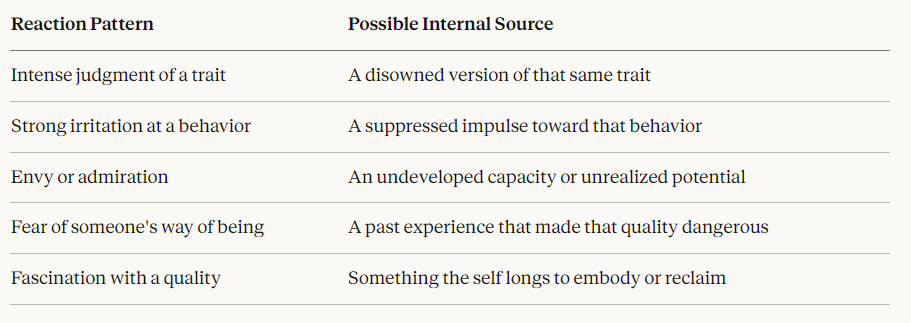
Importantly, the relationship is rarely one-to-one. You may react intensely to arrogance in others not because you are arrogant, but because you were conditioned to believe that self-assertion is unsafe, or that confidence makes you unworthy of love. The projection is symbolic as much as it is literal. Where there is emotional charge, there is almost always psychological information — even if the information is not obvious at first.
How to Recognize When Projection Is Being Directed at You
Projection does not only move outward from the self. It can also be directed toward you.
Disproportionate emotional reactions. Again, we consider the strength of the emotional reaction, this time not our own, but the one being directed toward us and our actions.
You are consistently accused of traits that do not align with your behavior. When someone attributes qualities to you that do not match your actual conduct — particularly when the accusations are repeated and resistant to correction — the accusations may be saying more about the projector's internal landscape than about you.
The interpretation collapses nuance into character indictment. A single instance becomes evidence of a fixed trait. One disagreement becomes proof of aggression. One boundary becomes proof of selfishness. Projection tends to operate in absolutes.
Clarification does not resolve the issue. Because the projection originates within the projector, external evidence rarely changes it. They are responding to an internal narrative. You are occupying a role in a story that was written before you arrived. This does not mean your behavior is irrelevant — but it does mean that explanation alone is unlikely to shift the dynamic.
How to Work with Projection Therapeutically
Rather than treating projection as a flaw to be eliminated, it can be engaged as psychological feedback — one of the most direct routes into the subconscious belief architecture. It is the subconscious revealing itself.
Every emotionally charged reaction can become a question: "What in me is being activated right now?"
This does not mean the external situation is irrelevant. Sometimes another person is behaving poorly. But projection invites us to examine the internal meaning attached to the situation — to move the inquiry inward rather than keeping it fixed on the other person.
The direction of that inquiry is always the same: from the reaction, backward toward the belief. From what is visible on the surface, downward toward what shaped it. The next section maps that process in more detail.
Going Deeper: Working With What Is Revealed
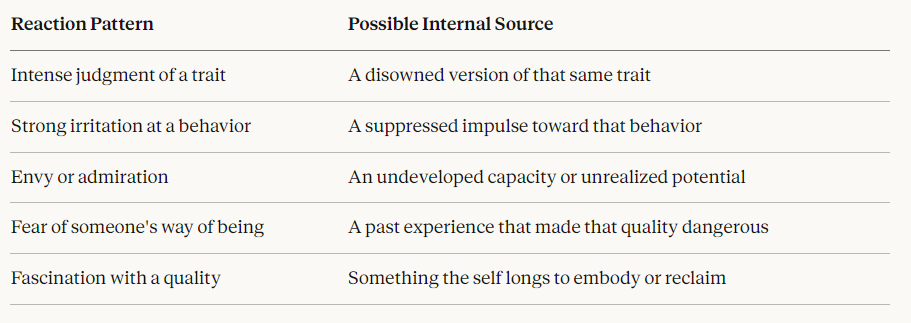
Revisiting these reaction patterns
The reaction pattern table is not a diagnostic tool. It is a map for inquiry — a set of coordinates that can help orient the question why does this affect me the way it does? toward something more specific than a general sense of being triggered.
The pairings work because interpersonal reactions — the flash of contempt, the slow burn of irritation, the quiet ache of envy — are rarely only about the person in front of us. They are also about the parts of ourselves that we have minimized, rejected, or never fully developed. Noticing a strong reaction to someone else is often, beneath the surface, an encounter with a part of the self that has not yet been fully seen.
Beginning the inquiry
The starting point is observation without verdict. Before moving to explanation, simply note what is present: I am having a strong reaction. What is it, exactly? Name the quality in the other person as precisely as possible — not "they bother me," but what specifically. Arrogant. Withholding. Reckless. Effortlessly confident. The precision matters because the reaction tends to fasten onto something particular, and that particularity is usually where the information lives.
From there, a useful orienting question is: when I feel this — the judgment, the irritation, the envy, the fear — what is this reaction trying to protect me from, or call me toward?
Reactions organized around protection tend to point toward something that once felt dangerous: a trait that was punished, a quality that drew criticism, a way of being that was made to feel incompatible with being loved or accepted. Reactions organized around longing tend to point toward something not yet claimed — a capacity that was discouraged, an aspect of self that got set aside early and has not been revisited since.
Tracing the source
Once the reaction is named and the orienting question has been asked, the inquiry moves backward — toward memory, early messages, and the relational patterns that shaped what became acceptable or unacceptable within the self.
This does not require excavating every formative experience. It requires a quality of gentle curiosity: where did I learn that this quality was dangerous, or shameful, or not available to me? Sometimes the answer arrives quickly. Sometimes it takes time. What matters is the direction of the inquiry — inward, rather than remaining fixed on the other person.
It also helps to distinguish between different kinds of internal sources, because the work they call for differs:
Disowned parts are traits that were actively rejected — qualities perceived as unacceptable, incompatible with the self-image required to remain safe or connected. These tend to produce the sharpest reactions: contempt, moral judgment, visceral dislike. The work here is recognition — not necessarily adopting the trait, but acknowledging its existence within the self and releasing the energy spent on its suppression.
Suppressed impulses are urges that were inhibited for safety or approval — things the self wanted to do or be that were foreclosed by circumstance or conditioning. These tend to produce irritation and resentment. The work here often involves examining whether the original prohibition still applies, and whether there are now safe ways to give the impulse some expression.
Undeveloped capacities are potentials that were simply never cultivated — not rejected so much as never reached. These tend to produce envy and admiration, and carry a different quality than disowned material: less charge, more ache. The work here is less about integration than cultivation — identifying what skill, permission, or practice might allow the capacity to develop.
Wounded associations are qualities that became linked to past harm — traits connected to experiences of danger, loss, or betrayal, so that encountering them in others activates the original wound. These tend to produce fear or hypervigilance. The work here involves distinguishing the present person from the past experience, and gradually updating the association.
A sequence for working with a reaction
When a strong reaction arises and you want to work with it rather than simply move past it, a useful sequence is:
First, name what is happening in the present moment — the specific quality in the other person, the specific feeling in yourself — without rushing to resolve it.
Second, locate it in the internal landscape. Using the table as a loose guide, ask which category of source most resonates: Is this something I have rejected in myself? Something I have suppressed? Something I have never developed? Something connected to an old hurt?
Third, recognize the protective function. The reaction exists for a reason. Whatever belief structure underlies it was written at a time when it served a purpose — when the disowning, the suppression, the vigilance made sense given the environment. That origin deserves acknowledgment before it is questioned.
Fourth, get curious about what the disowned or undeveloped part actually needs. Recognition, often. Safety to exist. Sometimes specific skills — the ability to assert, to receive, to set limits, to rest. The question is not how do I get rid of this reaction but what would it take for the part of me underneath this reaction to feel less threatened or less starved?
Fifth, experiment in small increments. Integration does not happen through insight alone. It happens through experience — small, low-stakes moments of acting differently, allowing a quality some expression, taking a risk that the old belief structure said was not safe. These experiments do not need to be dramatic. They need to be real.
Finally, reassess over time. The reaction that felt enormous at the start of this work often loses amplitude as the underlying material is met. If it does not — if the charge remains high despite inquiry — that persistence is itself information, and may point toward material that benefits from more structured support.
A note on the limits of the framework
The table offers pairings, not formulas. Not every strong reaction has a clean single source, and many have several operating simultaneously. The same trait in another person might activate a disowned part, a wounded association, and an undeveloped capacity all at once — each requiring a different kind of attention.
The framework is most useful when held lightly: as a set of questions to orient the inquiry, not a set of answers to close it. And when the material being worked with is particularly vulnerable — connected to significant loss, harm, or relational wounding — the pace of that inquiry matters as much as its direction. Curiosity is the posture. Gentleness is the method.
Integration: Reclaiming What Was Disowned
When projection is recognized, the goal is not self-condemnation. It is integration.
The trait that provokes the strongest reaction is often a capacity the self has not yet been allowed to develop. The person whose confidence irritates us may be pointing toward a freedom we have not yet permitted ourselves. The person whose ambition we quietly envy may reflect a strength we set aside because it once felt unsafe to claim.
Projection becomes less a distortion of reality and more a set of coordinates — pointing toward the parts of the psyche that are waiting to be seen, understood, and brought into conscious relationship with the self.
Our interactions with others do not simply show us other people. They show us the hidden architecture of our own inner world. Not because other people are merely reflections of us, but because our reactions to them reveal what remains unresolved, disowned, or undeveloped within us.
The Practice: A Single Shift in Orientation
Working with projection requires a reorientation, a slight shift in stance.
Moving attention from What they are doing
and toward Why does this affect me the way it does?
That question turns the ordinary traffic of human interaction into an ongoing source of self-knowledge. The world does not merely present us with other people. It presents us with mirrors — incomplete, imperfect, often uncomfortable — pointing toward the parts of the self that remain unseen.
And when those reflections are examined rather than reacted to, they become one of the most reliable guides available to understanding the deeper structures of the mind.
Nicole K. Gause, PhD, is a licensed clinical psychologist and founder of Silvering Psychological, a telehealth practice specializing in complex trauma and high-performance optimization work. She is licensed in Massachusetts and Pennsylvania.
